NPT tapered pipe fittings and mixed-interface adapters manufactured to customer drawings for hydraulic ports, instrumentation, fluid lines and OEM equipment.
NPT is a tapered pipe-thread connection. Pressure connections depend on controlled taper-thread engagement and an application-compatible sealant; the ability to screw threads together does not by itself demonstrate sealing. Straight fittings, elbows, tees, plugs, reducers, hose ends and conversion adapters can be machined to drawing. NPT must not be confused with NPTF, BSPT or straight-thread connections, and every port and conversion end must be confirmed separately.
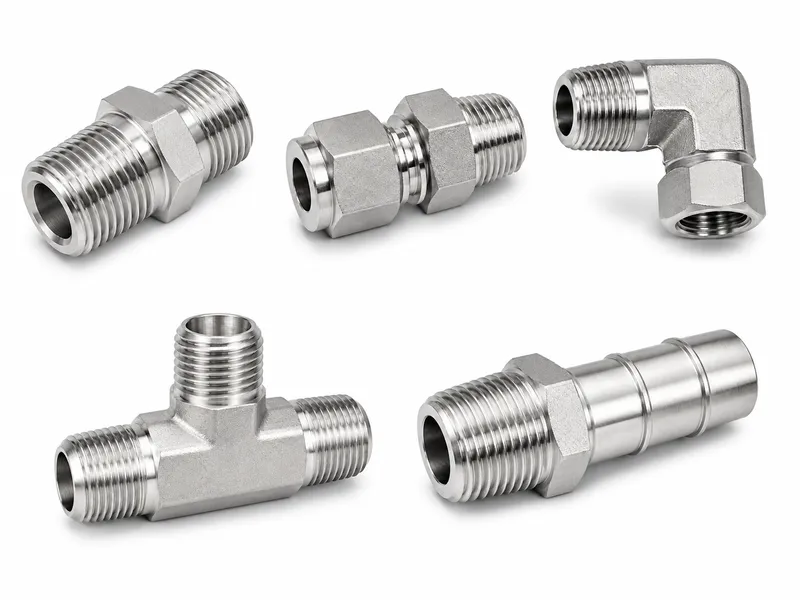
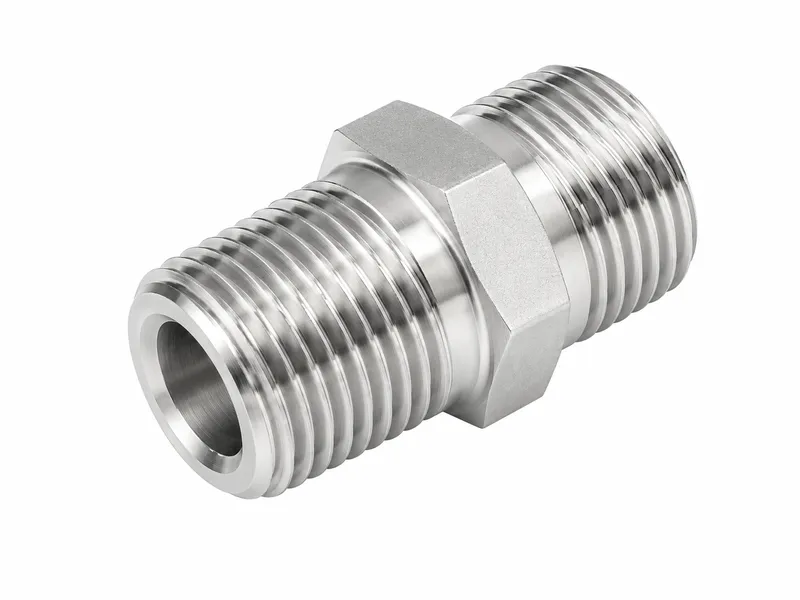
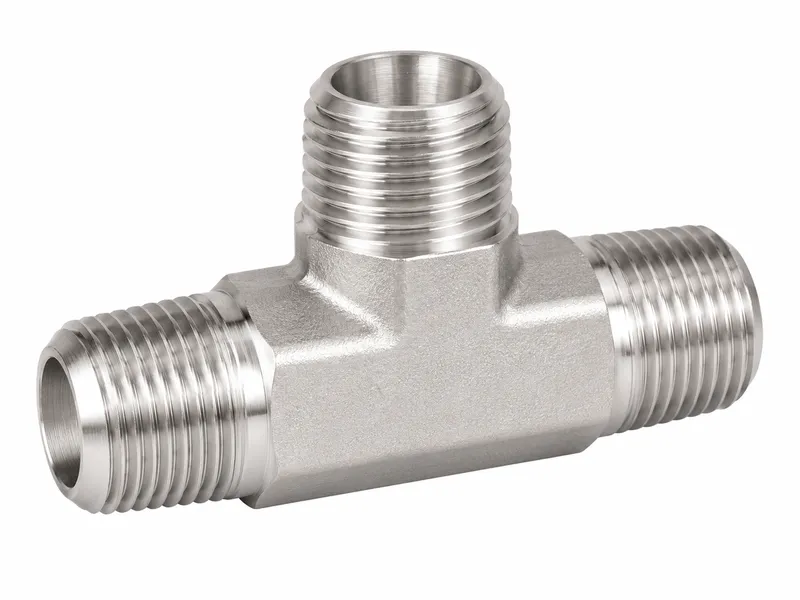
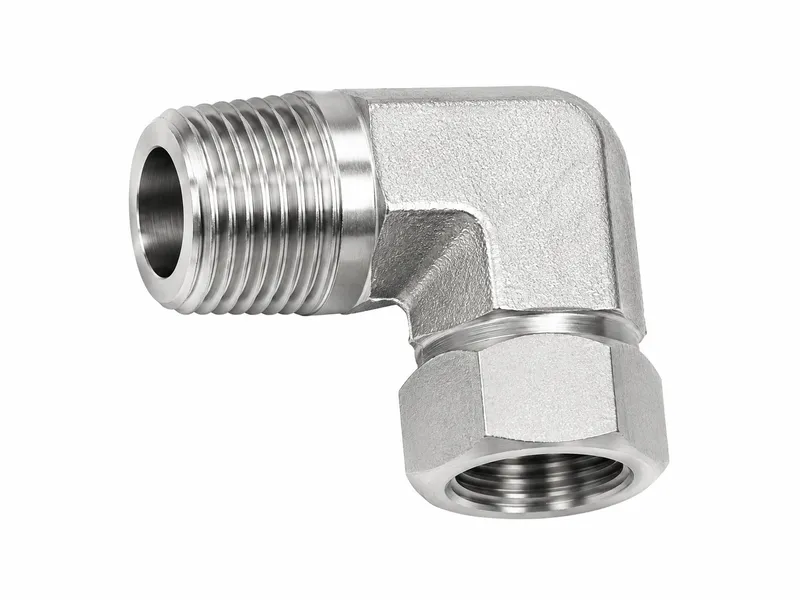
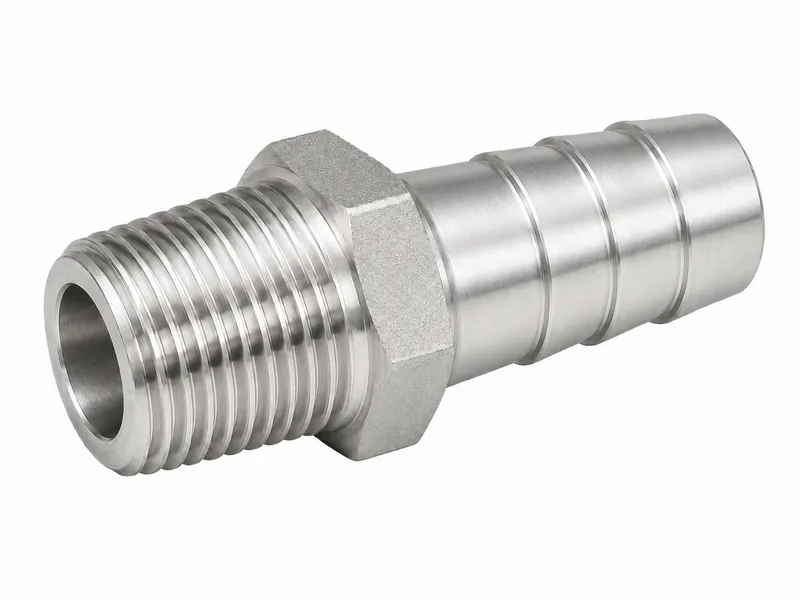
Wei Xing Machinery manufactures custom NPT pipe fittings, NPT hydraulic fittings and mixed-interface NPT adapters from customer-approved technical data. Applicable NPT taper-thread geometry can be manufactured according to ASME B1.20.1 when identified on the customer-approved drawing or order.
Production is based on the specified standard name and edition, geometry, material, finish and inspection plan—not a generic product-page assumption. Share each connection end and its sealing function for review.
| Product Type | Made-to-drawing NPT pipe fittings, adapters, reducers, plugs and conversion bodies |
|---|---|
| Thread Principle | American general-purpose tapered pipe thread; ordinary NPT and NPTF/Dryseal are different technical requirements |
| Applicable Standard | ASME B1.20.1 when specified for NPT; standard name and edition follow the approved drawing or order |
| Thread Form | Tapered, normally 60° for NPT; do not identify by appearance alone |
| Connection Ends | Male or female NPT and mixed interfaces; confirm every adapter end separately |
| Sealant Requirement | Ordinary NPT pressure connections normally combine controlled engagement with compatible sealant |
| Body Materials | Carbon steel, stainless steel; brass and other materials only after application review |
| Surface Finish | Drawing- and material-dependent coordinated finish |
| Manufacturing Basis | 2D drawing, 3D model, verified sample or order requirements |
| Inspection Basis | Customer-approved drawing and agreed inspection plan |
| Pressure / Validation Basis | No category-wide rating is defined here; capability depends on the complete connection and system validation |
| Applications | Hydraulic ports, instrumentation, auxiliary fluid lines, OEM machinery and verified retrofit projects |
Both male and female members are tapered. Engagement increases during tightening, and thread flanks plus the helical clearances form part of the connection. Ordinary NPT pressure service normally also needs a compatible sealant. Thread geometry, port condition, materials, sealant and assembly degree work together; sealant cannot correct serious damage, the wrong thread system or the wrong size.
Do not use excessive tightening to correct a mismatch. NPT's wedging action can expand a female port, crack thin walls, damage cast or brittle parts, deform threads and complicate later removal. No universal torque, turns-after-hand-tight or insertion depth applies across sizes, coatings, materials, ports, mating parts and sealants. During maintenance, remove old sealant and inspect threads, ports, burrs, corrosion, cracks, deformation and surface damage before reassembly.
| Feature | NPT | NPTF / Dryseal |
|---|---|---|
| General standard reference | Generally ASME B1.20.1 | Generally ASME B1.20.3 |
| Intended thread system | General-purpose taper pipe thread | Specified Dryseal pipe-thread system |
| Crest and root control | NPT geometry and tolerances | Different crest, root and tolerance controls |
| Typical sealing approach | Compatible sealant normally accompanies pressure connections | Dryseal geometry; sealing and assembly still follow the customer's system specification |
| Drawing identification | Must explicitly identify NPT | Must explicitly identify NPTF |
| Manufacturing and gaging requirement | Drawing-defined NPT process and appropriate gauges | Separately reviewed NPTF process and gauges |
| Interchangeability assumption | Do not treat the names as alternate spellings or infer interchangeability from engagement | |
Do not infer NPTF from the abbreviation “NPT” or from apparent thread engagement. NPTF is reviewed and machined only when the customer drawing or order explicitly specifies it. No claim is made that every NPTF connection in every medium and condition operates without sealant.
| Connection Type | Primary Sealing Location | Thread / Assembly Function | Selection Considerations |
|---|---|---|---|
| NPT | Taper-thread engagement and compatible sealant | Tapered threads progressively engage | Confirm size, gender, port and sealant |
| NPTF | Specified Dryseal geometry | Drawing-defined Dryseal engagement | Confirm explicit NPTF designation |
| BSPT | 55° tapered pipe-thread system and specified sealing method | Tapered connection | Do not interchange with NPT by appearance or initial engagement |
| BSPP | Determined by port and fitting design | Parallel thread provides retention or assembly force | Not the NPT sealing principle |
| JIC 37° | 37° metal flare faces | Straight thread provides clamping force | Protect and validate flare surfaces |
| ORFS | O-ring and flat face | Straight thread provides assembly force | Confirm O-ring, groove and face requirements |
NPT normally uses a 60° form, while BSPT normally uses a 55° Whitworth form. Diameter, pitch, taper definition, governing standard, gauges, sealing requirement and mating component may also differ. See the engineering guide to BSP and NPT thread identification.
NPSM, NPSC, SAE straight thread, ORB, JIC and ORFS straight threads, and BSPP must not be classified as NPT merely because threads are visible.
Drawing-specific production can cover male NPT straight adapters, female NPT adapters, male-to-female adapters, hex and reducing nipples, reducing bushings, plugs, applicable caps, 90° and 45° elbows, tees, hose-tail adapters, gauge and instrumentation adapters, and connectors to BSP, JIC, ORFS, metric or specified hose interfaces.
Available configurations depend on drawing review, tooling, material and production requirements; this list does not indicate stock availability. A hose-tail adapter is a component for a defined hose interface, not a completed hose assembly.
PTFE tape, compatible liquid sealant and paste-type pipe sealant are examples subject to fluid, temperature, material and system compatibility review. Match pressure, fitting and port material, maintenance procedure and customer specification; follow the sealant manufacturer's instructions.
Keep tape fragments and excess liquid out of the flow passage and meet system cleanliness requirements. Some systems require liquid or paste sealant, and some customers prohibit tape.
More tightening does not necessarily improve sealing. Thin-wall ports and cast parts require particular review; assemble to the customer or component manufacturer's specification.
Remove old sealant and check thread wear, coating damage, corrosion, deformation and port cracking. Reuse depends on inspection rather than an automatic assumption.
Depending on the fitting drawing, manufacturing may use CNC turning, required milling, external or internal NPT taper-thread machining, drilling, tapping, boring, hex and wrench-flat machining, cross holes, reducer and bushing machining, plug or cap body machining, and specified hose-tail machining. NPTF machining is considered only when explicitly specified.
Deburring, cleaning, dimensional inspection and appropriate thread-gauge inspection are incorporated according to the agreed plan. Surface finishing can be coordinated according to material and order requirements. Not every fitting requires every operation.
Carbon steel and stainless steel are reviewed against the drawing. Brass is considered only after media, mechanical and project review; other materials are subject to drawing and application review. The customer drawing or order specifies the grade.
Options may include trivalent zinc plating, zinc-nickel coating, black oxide, phosphating where applicable, natural stainless finish, or passivation when specified and material-compatible.
A finish does not replace correct material selection, thread-sealing design or system corrosion design.
Inspection planning may cover drawing and revision review, standard designation and edition, NPT versus NPTF identification, material documentation, external and internal taper threads, appropriate NPT plug or ring gauges, agreed mating references, taper engagement and position, overall and thread length, hex size, bore, flow passage, cross holes, specified wall thickness, edge break, deburring, cleanliness and finish appearance.
Sampling or full dimensional inspection follows the agreed plan. Pressure or leak testing is performed only when explicitly specified; different designs do not automatically receive the same gauges or test plan.
“NPT fitting” alone is not enough for an accurate quotation. At minimum confirm NPT or NPTF, nominal size, male or female form, every end or port, opposite-end standard, body configuration, material and application conditions.
Submit a 2D drawing, a 3D model when available, or an approved sample with verified dimensions. Include the required bore or flow passage, surface finish, quantity, target application, operating media, temperature range, pressure or validation requirement, permitted or prohibited sealant, inspection and documentation requirements, and packaging requirement.
Wei Xing Machinery manufactures from customer-approved drawings, models, verified samples and order requirements. The customer or system designer is responsible for connection selection, pressure rating, media compatibility, sealant, assembly requirements and complete-system validation. Sample appearance alone cannot define NPT versus NPTF, taper, pitch, tolerance, material or standard edition. NPT and BSPT must not be substituted without verification, and every conversion-adapter end must be reviewed separately. A fitting webpage cannot determine complete-system pressure capability; final acceptance follows the approved drawing and agreed inspection plan.
NPT pipe fittings use the American general-purpose tapered pipe-thread system for ports and adapters. Applicable geometry can be manufactured to ASME B1.20.1 when that standard is identified on the customer-approved drawing or order.
Male and female tapered threads progressively engage. Thread geometry, flank contact, port condition, materials, compatible sealant, controlled assembly and complete-system validation all affect sealing; engagement alone does not establish sealing performance.
An ordinary NPT pressure connection normally uses a compatible pipe-thread sealant. PTFE tape, liquid sealant or paste are only examples subject to fluid, temperature, material and system compatibility review and the sealant manufacturer's instructions.
Ordinary NPT generally references ASME B1.20.1, while NPTF/Dryseal generally references ASME B1.20.3 and has different crest, root, manufacturing and inspection controls. We review NPTF only when explicitly specified, and do not assume every NPTF application needs no sealant.
No interchangeability should be assumed. NPT normally has a 60° thread form and BSPT normally has a 55° Whitworth form; diameter, pitch, taper definition, standard, gauges, sealing requirements and mating parts may also differ.
Provide NPT or NPTF identification, nominal size, male or female form, every port and opposite-end standard, body configuration, material, quantity, application conditions, drawing or verified dimensions, finish and inspection requirements.
Carbon steel and stainless steel are considered from the drawing. Brass requires media, mechanical and project review. Finishes may include trivalent zinc, zinc-nickel, black oxide, applicable phosphating, natural stainless or specified compatible passivation.
Yes. We review drawing-specific NPT hydraulic adapters, including NPT-to-BSP, NPT-to-JIC, NPT-to-ORFS, metric and hose interfaces. Each end, sealing location, mating part and assembly requirement must be defined separately.
Submit the drawing, NPT or NPTF designation, thread size, port details, opposite-end connection, material, quantity and application requirements for manufacturing review and quotation.